
The idea of digital cash seems obvious today, but before Bitcoin, it was nearly impossible.
Every form of electronic payment had to go through a trusted intermediary.
Cash worked without trust, but required both parties to meet in person.
Digital payments worked at a distance, but always relied on a third party who held the power to delay, block, or reverse transactions.
This split created two very different worlds for money.

Two Types of Payments Before Bitcoin
Before Bitcoin, all payments fell into two clear categories.
1. Cash Payments (Peer-to-Peer)
The cash was fast. Cash was final. Cash required no trust and carried no risk of reversal.
But cash only worked when both parties were physically present.
This became a problem as communication expanded and people needed to transact across long distances.
2. Intermediated Payments (Third-Party Controlled)
Intermediated payments include:
-
Checks
-
Credit cards
-
Debit cards
-
Bank transfers
-
Money transfer services
-
PayPal and similar platforms
These tools solved the distance problem.
But they introduced a new one: trust.

The Cost of Trust: When Middlemen Control Your Money
Every transaction required faith that the middleman would execute it honestly, without failure, fraud, censorship, or delays.
This trust came with real risks:
-
Technical outages
-
Hacks
-
Fraud
-
Surveillance
-
Frozen accounts
-
Government-ordered payment blocks
-
Slow clearing times
In intermediated systems, money was never fully yours.
It was always subject to someone else’s approval.
Why Digital Money Was Impossible Before Bitcoin
Digital objects are easy to copy. A photo, a file, or a song can be duplicated endlessly.
This made digital cash impossible.
If you sent someone a “digital coin,” nothing stopped you from sending that same coin again.
This problem is known as double-spending.
The Double-Spending Dilemma: Why Digital Money Required Trusted Third Parties
To prevent double-spending, digital payments had to rely on a trusted authority keeping a ledger.
Naturally, that authority gained enormous power over users and their money.
Cash stayed physical.
Digital payments stayed intermediated.
There was no bridge between the two—until Bitcoin.

For anyone who wants to skip the hype and learn the real process, I covered it in this [straightforward guide to buying Bitcoin safely].
Bitcoin: The First True Digital Cash
After decades of experiments by programmers and cryptographers, Bitcoin became the first working form of digital cash.
It solved the double-spending problem without requiring trust in any third party.
It did this by becoming the first digital object that is verifiably scarce.
This breakthrough changed everything.
Why Digital Cash Matters
Intermediated payments expose users to:
-
Security risks
-
Political censorship
-
Surveillance
-
Account freezes
-
Fraud
-
Delayed settlement
Bitcoin removes all of these by design.
It gives people back the sovereignty that physical cash once provided—only now in a digital, borderless, 24/7 form.
How Bitcoin Restores Monetary Sovereignty
Physical cash always offered two powerful properties:
-
Fungibility — every unit is identical
-
Liquidity — it can be spent instantly at market value
Intermediated systems weaken both.
Political controls, bank policies, and surveillance restrict when and how you can use your own money.
Modern life made physical cash harder to use, but digital payments made money easier for governments and corporations to monitor and control.
Bitcoin’s Purpose: Restoring Individual Sovereignty Over Wealth
At the same time, the move away from gold toward fiat currencies gave central banks full control over the money supply.
People lost sovereignty over both their transactions and their savings.
Bitcoin was designed to fix this.
Satoshi’s Goal: Pure Peer-to-Peer Digital Cash
Satoshi Nakamoto set out to create:
-
A peer-to-peer electronic cash system
-
No trusted third parties
-
A supply that cannot be altered
This meant combining the best features of physical cash—finality, freedom, sovereignty—with a monetary policy stronger than gold.
Trustless Revolution: The Four Technologies That Built Bitcoin
To do this, Satoshi relied on a combination of advanced but little-known technologies:
-
Distributed peer-to-peer networking
-
Hashing
-
Digital signatures
-
Proof-of-work mining
Together, these unlocked something the world had never seen: trustless digital transactions.
Verification: The Heart of Bitcoin
Bitcoin replaces trust with math and verification.
Every node stores a full copy of the ledger.
Every transaction must be validated by the entire network.
Miners compete to add a new block roughly every ten minutes.
They do this by solving a proof-of-work puzzle that is difficult to complete yet easy to verify.
Miner Incentives: Block Rewards and Fees—The Anti-Central-Bank Engine
This structure ensures:
-
No fraudulent transaction can enter the ledger
-
No authority can rewrite history
-
No one can inflate the supply
-
No one can freeze or block a valid payment
The miner who solves the proof-of-work receives:
-
Newly created bitcoins (block reward)
-
All transaction fees in that block
This is Bitcoin’s replacement for central banks.

The Genius of Difficulty Adjustment
Proof-of-work alone is not enough.
Without limits, miners could increase production when Bitcoin rises in value.
This would inflate the supply, just as happens with gold, silver, and fiat currencies.
Bitcoin prevents this through difficulty adjustment.
Every two weeks, the network adjusts the difficulty so that new blocks always take about ten minutes—no matter how much computing power miners add.
Hardness Redefined: The First Truly Fixed Monetary Asset
This innovation gives Bitcoin:
-
The lowest stock-to-flow inflation of any money
-
Perfect predictability
-
Immunity to supply manipulation
-
A monetary hardness unmatched in history
Even if Bitcoin’s price skyrockets, miners cannot increase supply.
They can only increase the security of the network.
This makes Bitcoin the hardest money ever invented.
Bitcoin vs. Every Other Form of Money
Throughout history, when a money rises in value:
-
People try to produce more of it
-
Its supply increases
-
Its value eventually crashes
A History of Failed Money: From Rai Stones to Fiat Currencies
This happened with:
-
Rai stones
-
Seashells
-
Silver
-
Gold
-
Fiat currencies
-
Government-controlled money
Gold was the hardest money before Bitcoin, but a rising gold price still leads to higher gold production over time.
Bitcoin breaks this cycle.
No matter how high the price goes:
-
The supply does not increase
-
The network only becomes more secure
-
Inflation remains fixed
-
Hardness remains absolute
This is monetary engineering no civilization has ever seen.
Unstoppable by Design: How Asymmetric Costs Secure the Network
Bitcoin achieves this through an asymmetry:
-
Cost to validate a block is nearly zero
-
Cost to produce a fraudulent block is enormous
A bad actor wastes massive energy attempting an invalid block, but honest nodes reject it for free.
This is what makes Bitcoin unstoppable.
Bitcoin’s Ledger: Verification Without Trust
Bitcoin becomes harder to change as time passes.
Each block added to the chain represents real energy and real work.
To rewrite old history, an attacker would need more energy than the entire network used to create it.
This cost grows every hour, making changes practically impossible.
That is why Bitcoin offers a ledger that is beyond dispute.
It is built on 100% verification and 0% trust.
Bitcoin and the Rai Stones: A Digital Parallel
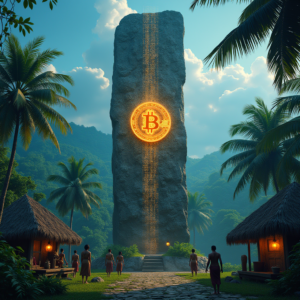
Bitcoin’s ledger works in a way that mirrors the Rai stones of Yap.
On Yap, villagers did not move the stones.
They only announced who owned each one, and everyone remembered.
Bitcoin does the same, but on a global, digital scale.
The Transaction Lifecycle: How Bitcoin Moves Without Moving
When someone sends bitcoin, the sender broadcasts the transaction to the entire network.
Nodes verify that the sender has the required balance.
Once verified, ownership updates on the shared ledger.
The coins themselves never “move.”
Only the entries change.
Final and Sovereign: The Unforgiving Nature of Bitcoin Ownership
Ownership is tied to a public address, not a person’s name.
Access is controlled by a private key, which works like a password.
If someone steals your key, they steal your coins—just as taking your gold or cash would be final and irreversible.

Why Bitcoin Scales Far Beyond Ancient Money
The Rai stones were impressive, but they had limits.
They were too large to divide.
They could only serve a small island with a small population.
Decentralized Integrity: The Engine That Keeps Bitcoin Honest
Bitcoin removes these barriers:
-
Maximum of 21,000,000 coins
-
Each coin splits into 100,000,000 satoshis
-
This makes Bitcoin highly salable across all scales
-
Anyone with an internet connection can use it
Bitcoin is global money that works for micro-payments and billion-dollar transfers alike.
What Keeps Bitcoin Honest
Dishonest nodes gain nothing.
They are rejected instantly by the rest of the network.
Fraud costs them energy, but earns them nothing.
What prevents large-scale collusion?
Simple: breaking Bitcoin destroys the very asset they hope to steal.
Incentivized Honesty: Why Cheating the System Destroys the Reward
If a majority altered the ledger:
-
Trust in Bitcoin would collapse
-
The currency would become worthless
-
Their “reward” would turn to zero
Bitcoin’s rules survive because breaking them is always more costly than following them.
No Single Point of Control
No government, company, or individual controls Bitcoin.
No one can alter the ledger alone.
The software running on thousands of independent nodes decides whether a transaction is valid.
Consensus—not authority—keeps Bitcoin alive.
Ralph Merkle, who invented the Merkle tree used in Bitcoin, described it perfectly:
“Bitcoin is the first example of a new form of life…
It can’t be changed. It can’t be argued with. It can’t be corrupted.
It can’t be stopped. It can’t even be interrupted.”

Borderless by Design: The Global, Leaderless Network
This “digital organism” lives because:
-
It pays miners to secure it
-
Anyone can run a node
-
Faulty copies are discarded automatically
-
The network exists across many countries
-
It needs no leader
Bitcoin survives because people choose to use it.
Bitcoin as an Autonomous Economic System
Bitcoin behaves like a self-running firm.
It provides two services:
-
A new form of money
-
A global payments network
There is no management team. No corporate board.
Only code, incentives, and voluntary participation.
The Bitcoin Economic Engine: How Security and Demand Reinforce Each Other
Here is how the economics work:
-
Miners invest electricity and hardware to secure the network
-
Users pay transaction fees and buy coins
-
Higher demand increases miner rewards
-
Higher rewards increase mining power
-
More mining power increases network security
Demand fuels security. Security fuels confidence. Confidence fuels more demand.
This feedback loop has driven Bitcoin’s growth since 2009.
SECEDE FROM THE BANKING CABAL
Join the financial rebellion against international bankers and their usury system.
Take back your sovereignty with sound money.
Opt Out of the Banking Empire
Every dollar kept inside the global banking system strengthens the same institutions that profit from inflation, control, surveillance, and endless debt. Bitcoin lets you step outside their reach. No permission. No middlemen. No currency debasement.
This is financial rebellion for the digital age — sound money for people who refuse to kneel to international banks, central planners, and broken monetary systems.

Start with a small stake. Exit the fiat trap. Build real digital wealth.
The Invention of Digital Scarcity
Before Bitcoin, digital objects could be copied infinitely.
Nothing online was scarce.
Bitcoin changed that.
When you send bitcoin, you no longer own it.
It does not remain with the sender the way files do.
This makes Bitcoin the world’s first digitally scarce asset.
But it also introduced something even more radical: Absolute scarcity.
Bitcoin’s Unique Scarcity: The Digital Gold Standard
Bitcoin is the only liquid asset—digital or physical—with a fixed quantity that cannot be increased.
Nothing else, not even gold, can make that claim.
Because of this, Bitcoin becomes extremely salable across time.
Its value cannot be inflated through higher production, no matter the price.
This is what makes Bitcoin such a powerful long-term store of value.
The Birth of a New Monetary Reality
Bitcoin represents a major turning point in monetary history.
For the first time, the world has access to digital cash that requires no trust in banks, governments, or financial intermediaries.
- It offers verification instead of promises.
- It offers scarcity instead of inflation.
- It offers sovereignty instead of permission.
Bitcoin and the Future of Financial Freedom
Bitcoin blends the strongest traits of past monetary systems like the hardness of gold and the finality of physical cash with the speed and reach of modern communication networks.
Nothing before it has combined security, scarcity, and global accessibility at this scale.
As more people understand the limits of traditional money, Bitcoin stands ready as the alternative that cannot be inflated, seized, or shut down.
Shaping Economic Destiny: Bitcoin’s Role in the Next Financial Era
Its network gets stronger as its value grows.
Its rules do not bend to power.
Its supply does not change with politics.
Bitcoin is not only a new form of money.
It is a new financial foundation.
And it may shape the next era of human economic life just as gold and paper money shaped the last.