
You have heard the criticism. “Bitcoin is too slow.” “The fees are ridiculous.” “You can’t buy a coffee with it.”
For using the base Bitcoin blockchain, these complaints are often valid.
A confirmation can take ten minutes or more. The fee might be higher than your purchase.
This makes Bitcoin impractical for daily spending. But this criticism misses a revolutionary upgrade.
Bitcoin has a solution built directly on top of it. This solution is called the Lightning Network.
It turns Bitcoin from a slow savings technology into a instant payment system.
Scaling Bitcoin the Right Way: A Lightning Overview
This post will explain how the Lightning Network works in simple terms.
We will show you how it enables instant, near-free transactions.
You will learn how to set up a Lightning wallet yourself.
Let’s solve the speed and cost problem once and for all.
If you’re brand new and want a simple, no-nonsense walkthrough, this Rebel’s Guide to Buying Bitcoin breaks down everything step by step.
The Problem: Why the Base Layer is Built for Savings, Not Spending
First, let’s understand the bottleneck. The main Bitcoin blockchain is like a supreme court.
It is designed for final, secure, and irreversible settlements.
Every transaction is recorded forever on a public ledger.
This process is deliberately slow and resource-intensive to ensure maximum security and decentralization.
- Block Time: A new block is added roughly every 10 minutes.
- Limited Space: Each block has a limited data capacity.
- High Security: This design makes Bitcoin incredibly secure but slow for small, frequent payments.
Trying to buy a coffee on the base layer is like taking a supreme court case to settle a $5 debt.
It is overkill. The process is too slow and expensive for the task.
The Lightning Network was created to handle these everyday payments.
The Solution: What is the Lightning Network?
The Lightning Network is a second-layer protocol.
It operates on top of the Bitcoin blockchain.
Think of it as a network of private tabs opened between friends at a bar.
Instead of settling every single drink with the cashier (the blockchain), you run a tab.
You and your friend keep track of who owes what.
Only when you close the tab at the end of the night is a single settlement transaction sent to the cashier.

Why Lightning Is Fast: Moving Transactions Off-Chain
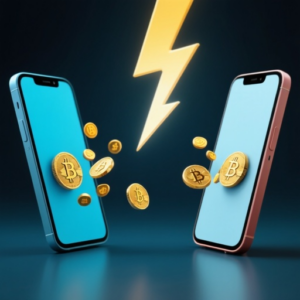
The Lightning Network applies this concept to Bitcoin. It creates private payment channels between users.
An unlimited number of transactions can happen inside this channel instantly and for almost no cost.
Only the opening and closing of the channel are recorded on the main Bitcoin blockchain.
How It Works: The Payment Channel Analogy
Let’s walk through a simple example.
1.) Opening a Channel (Setting up the Tab):
Alice and Bob want to transact frequently. They open a Lightning channel.
To do this, they both commit some Bitcoin—say, Alice puts in 0.05 BTC and Bob puts in 0.02 BTC—into a secured, multi-signature wallet.
This opening transaction is broadcast to the main Bitcoin blockchain.
It’s the only time they pay a standard Bitcoin fee.
2.) Instant, Free Transactions (Running the Tab):
Now the channel is open. Alice buys a coffee from Bob for 0.001 BTC.
Instead of broadcasting this to the whole network, they simply update their private balance sheet.
Alice’s new balance is 0.049 BTC; Bob’s is 0.021 BTC.
This update is instantaneous and costs nothing. They can do this thousands of times.
3.) Closing the Channel (Settling the Tab):
When they are done transacting, one of them closes the channel.
The final balance sheet—showing Alice with 0.049 BTC and Bob with 0.021 BTC—is broadcast to the main blockchain in a single closing transaction.
This is the second and last time they pay a Bitcoin fee.This is the core genius of Lightning.
It moves the vast majority of transactions off-chain, reserving the robust but slow main chain for final settlement.
Before you think Bitcoin is too expensive, this post explains why owning sats is what really matters.
The Network Effect: Routing Payments
But what if Alice wants to pay Carol, and they don’t have a direct channel?
This is where the true power of Lightning shines.
If Alice has a channel with Bob, and Bob has a channel with Carol, Alice can pay Carol through Bob.
The network finds a path. The payment is routed through connected channels.
Each node along the path takes a tiny, microscopic fee for facilitating the routing.
This creates a web of interconnected channels, allowing anyone to pay anyone else, even without a direct connection.
Your Toolkit: Top Lightning Wallets to Use Today
Using the Lightning Network is surprisingly easy. You just need a compatible wallet.
Here are some of the best options for you, categorized for different users.
For Beginners (Custodial – Easiest Start):
These wallets are like a bank for Lightning. The service holds your funds, making setup instant and simple.
This is a great way to try Lightning with small amounts.
- Wallet of Satoshi: The simplest Lightning wallet. Download, and you’re ready to send and receive instantly. Perfect for your first experience.
- Cash App: Allows you to buy Bitcoin and send/receive via Lightning directly within a familiar app.
- Strike: Focuses on seamless fiat-to-Bitcoin conversion over Lightning, great for cross-border payments.
*Reminder: with custodial wallets, you do not control the private keys. As the saying goes—“not your keys, not your crypto.”
For Intermediate Users (Non-Custodial – More Control):
These wallets give you control over your funds (your keys, your coins).
They require a bit more setup but offer greater sovereignty.
- Phoenix Wallet (by ACINQ): An excellent balance of simplicity and self-custody. It automatically manages your channels in the background. A top choice for Android and iOS.
- Breez Wallet: A powerful non-custodial wallet with advanced features like a built-in podcast player that lets you stream and pay with sats simultaneously.
- Muun Wallet: Unique because it seamlessly combines on-chain and Lightning balances. It’s non-custodial and very user-friendly.
For Advanced Users (Node Management):
These are for users who want to run their own Lightning Node for maximum control and to earn routing fees.
- Zeus: A mobile app that connects to your own node (like Umbrel or myNode) giving you full control from your phone.
- Lightning Node (LND) with a UI like RTL: For those running a node on a home server.
You can easily fund any of these wallets.
With a service like Swan Bitcoin allows you to set up automatic buys and withdraw your Bitcoin directly to your Lightning wallet when you’re ready to spend.
Lightning Network vs. Base Chain: A Clear Comparison
This table shows the dramatic difference between the two layers.
|
Feature
|
Bitcoin Base Layer
|
Lightning Network
|
|---|---|---|
|
Transaction Speed
|
10 minutes to several hours
|
Instant (1-3 seconds)
|
|
Transaction Cost
|
$1 – $50+ (volatile)
|
<$0.01 (often fractions of a cent)
|
|
Best Use Case
|
High-value savings, large transfers
|
Micro-payments, daily spending, streaming payments
|
|
Security Model
|
Maximum (Proof-of-Work)
|
Very High (backed by base layer)
|
|
Example
|
Buying a car, storing life savings
|
Buying coffee, tipping online, paying for a news article
|
As you can see, they are complementary. Use the base layer for your long-term “savings account.”
Use the Lightning Network for your daily “checking account.”
Answering the Critics: Is Lightning Secure?
A common concern is whether off-chain transactions are secure.
The answer is a resounding yes, thanks to a clever cryptographic tool called a Hash Time Locked Contract (HTLC).
An HTLC acts as a smart contract within a payment channel.
It ensures that if someone tries to cheat by broadcasting an old balance, the other party has time to claim all the funds in the channel as a penalty.
This makes cheating economically irrational and keeps all participants honest. Your funds are safe.
The Future is Lightning Fast
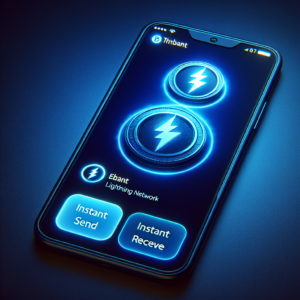
The Lightning Network completes the vision of Bitcoin as a peer-to-peer electronic cash system.
It solves the scalability problem without compromising the security of the base layer.
It enables entirely new economies of micro-payments, from paying per article you read to tipping a content creator instantly.
So, is Bitcoin too slow for small purchases? On the base layer, yes.
But with the Lightning Network, Bitcoin becomes the fastest, cheapest, and most secure payment system in the world.
It is no longer just digital gold. It is digital cash.Download a Lightning wallet today.
Send a few cents to a friend. Experience the future of money for yourself.