
Of all the forms of money found in history, one stands out as the closest match to how Bitcoin works.
It is the ancient monetary system built around Rai stones on Yap Island, now part of the Federated States of Micronesia.
These stones were huge circular discs carved out of limestone.
Even though they could not be moved easily, they still worked as a reliable form of money.
Hardness, Trust, and the End of Stone Money
The way this system operated helps us understand how Bitcoin functions.
In The Bitcoin Standard, this comparison becomes clearer later in the discussion.
The story of how Rai stones eventually lost their role as money also teaches a powerful lesson.
When a money loses its hardness, it loses its value—and people stop using it.
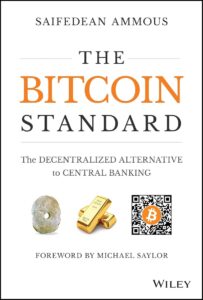
If you’re brand new and want a simple, no-nonsense walkthrough, this Rebel’s Guide to Buying Bitcoin breaks down everything step by step.
Why Rai Stones Matter for Understanding Bitcoin
To see why Rai stones were once considered “hard money,” it helps to look at what made them valuable to the people of Yap.
Their size, difficulty to produce, and limited supply gave them strength.
When that hardness disappeared, their monetary role collapsed.
Here’s what made Rai stones special:
-
They were extremely hard to produce.
-
Their supply was naturally limited.
-
Everyone on the island recognized them as money.
-
Ownership was recorded socially, not physically—just like Bitcoin uses a ledger.
This makes them an ideal starting point for understanding Bitcoin’s deeper mechanics.
The Inherent Value of Difficulty: Transportation Dangers
The Rai stones used as money came in many sizes.
Some were enormous circular disks with a hole in the center.
The largest could weigh up to four metric tons.
Yap Island did not have limestone, so none of these stones were native to the island.
All of them were transported from Palau or Guam.
This made the stones rare, beautiful, and highly valued.
However, getting them was extremely hard.
Quarrying them took great effort. Transporting them by raft or canoe took even more.

Why Rai Stones Were Considered “Hard Money”
Bringing a stone to Yap often required hundreds of people.
When the stone finally arrived, it was placed in a public spot where everyone could see it.
Ownership worked in a simple, yet powerful way.
The stone did not have to move for a payment to happen.
Theft-Proof by Design: When Everyone Knows the Books
The owner only needed to announce to the town that the stone now belonged to someone else.
Everyone would acknowledge the new owner.
That person could later use the stone to make their own payment.
This system made theft almost impossible.
The community knew who owned each stone, so stealing one had no point.
The real “ledger” was the memory and agreement of the people.
Hard Money Defined: Lessons from Ancient Yap
Here’s why this monetary system worked:
-
The stones were scarce.
-
They were extremely costly to produce.
-
Their ownership was publicly known.
-
Their value depended on social consensus, not physical movement.
This makes the Rai system one of the clearest historical examples of hard money before the digital age.

Millennial Money: A System That Stood the Test of Time
The Rai stone system worked for centuries, and possibly even millennia.
The stones never moved, yet they could be used for payment anywhere on the island.
This gave them strong salability across space.
Their different sizes also helped with salability across scales.
People could even use fractions of a stone for certain payments.
Inflation Resistance: Built by Difficulty and Distance
Salability across time was strong as well.
The difficulty of quarrying the stones and shipping them from Palau or Guam made new stones extremely rare.
Because of this, the existing supply was always much larger than the new supply added in any given period.
That meant no one could inflate the money supply easily.
Why Rai Stones Had a High Stock-to-Flow Ratio
Rai stones stayed valuable because they were very expensive to produce.
Their stock-to-flow ratio stayed high.
Even if the stones were desirable, few people could create new ones.
The islanders could trust the stones to hold value.
But that stability ended in 1871.
An Irish-American sea captain named David O’Keefe was shipwrecked on Yap and rescued by the locals.
His arrival changed everything.
To understand O’Keefe’s impact, his story became famous enough to inspire a novel—His Majesty O’Keefe by Laurence Klingman and Gerald Green (1952)—and a Hollywood film starring Burt Lancaster in 1954.

Key Points That Made the System Function
-
Stones were extremely expensive to create.
-
New supply was tiny compared to the total supply.
-
They were accepted everywhere on the island.
-
Fractional payments were possible.
-
The stock-to-flow ratio stayed high for centuries.
-
Inflation was nearly impossible—until O’Keefe arrived.
This sets the stage for how the Rai system destabilized once new production became easy.

The Outsider’s Scheme: Exploiting an Ancient System
O’Keefe realized he could make money by buying coconuts from the islanders and selling them to coconut-oil producers.
But he had a major problem. The locals had no need for foreign money.
They were content with their lives.
They lived in a tropical paradise with everything they needed.
No currency O’Keefe carried could motivate them to work for him.
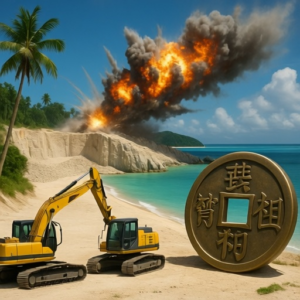
But he refused to give up. He sailed to Hong Kong, bought a large boat, and filled it with explosives.
Then he went to Palau and used the explosives and modern tools to quarry several new Rai stones.
After that, he sailed back to Yap with these stones, hoping the islanders would accept them as payment for coconuts.
O’Keefe’s Stones Destroy the Hardness of the Money
O’Keefe expected gratitude. Instead, he was shocked.
The villagers rejected his stones.
The village chief even banned the townsfolk from accepting them.
He declared that these stones had no value because they were gathered too easily.
Only stones quarried with the sweat and blood of the Yapese were to be recognized as money.
Fractured Trust: The True Cost of Broken Consensus
However, not everyone agreed.
Some islanders accepted O’Keefe’s stones and traded coconuts to him anyway.
This disagreement sparked conflict.
In time, it destroyed the monetary role of Rai stones.
They could no longer serve as hard money.
Today, Rai stones remain on the island.
But they serve more as cultural symbols and ceremonial objects.
Modern government money has replaced them as the common medium of exchange.
Key Lessons From O’Keefe’s Impact
-
Money loses value when production becomes too easy.
-
Inflation destroys trust—even in ancient systems.
-
Social consensus, not just objects, gives money its power.
-
Hard money must remain hard, or it collapses.
The Rai stones show what happens when hardness disappears: the money dies.
Beyond O’Keefe: The Systemic Shift to Fiat Conditions
O’Keefe’s story is powerful, but he was not the only cause of the collapse of the Rai system.
He was simply the first sign of a larger change.
As modern industrial tools reached Yap, everything shifted.
Quarrying stones became easier.
Transporting them became cheaper.
And the entire island found itself exposed to a new economic reality.
Technological Disruption: The End of Monetary Scarcity
With these new technologies, the old difficulty of producing Rai stones collapsed.
The stock-to-flow ratio dropped fast. This meant new stones could flood the island far more quickly than before.
When supply grows faster than expected, trust breaks down.

How Modern Tools Destroyed the Value of Rai Stones
Once modern tools arrived, many people—local and foreign—became capable of producing Rai stones.
They no longer required massive crews or long journeys. This changed the money forever.
The island’s existing supply was no longer precious.
It could now be inflated.
As a result, Rai stones lost their usefulness as a store of value.
If people could create more stones every year, no one could trust them to hold worth over time.
And once a money loses its salability across time, it also loses its role as a medium of exchange.
What Went Wrong With Rai Stones
-
Modern technology lowered production costs.
-
Stock-to-flow ratio collapsed.
-
New supply outpaced old supply.
-
Trust in the stones disappeared.
-
Salability across time evaporated.
In the end, the stones could no longer function as money.
The island needed something harder—something inflation could not easily destroy.
Historical Pattern: The Inevitable Decline of Soft Currency
The specific details may change from one society to another, but the pattern stays the same.
When the stock-to-flow ratio of a money falls, that money begins to fail.
It loses its strength. It loses trust. And eventually, it loses its role as money.
This dynamic appears again and again throughout history.
It continues even today.
As these words are written, the Venezuelan bolivar is collapsing for the same reason.
When Stock-to-Flow Falls, Money Dies
Every monetary failure shares this core cause.
Once new supply becomes easy to produce, people stop saving in that currency.
They look for something harder.
They look for something that holds value through time.
And this universal dynamic helps explain why Bitcoin’s fixed supply matters so much in the modern world.

Hard Money Survives Because It Cannot Be Cheated
When we look across history, the same lesson repeats itself.
Money loses value when its supply becomes easy to copy or produce.
This pattern appeared with the Rai stones of Yap, with early commodity forms of money, and with modern national currencies like the Venezuelan bolivar.
Once the stock-to-flow ratio drops, trust evaporates.
People abandon the old money and move toward something harder.
A New Hope: How Bitcoin Completes the Story of Rai Stones
Bitcoin enters this story at the perfect moment in history.
It cannot be inflated at will. Its supply is fixed. Its ledger is transparent.
And its hardness is protected by code instead of physical labor.
Bitcoin revives the qualities that once made the strongest forms of money survive for centuries.
If you want to begin exploring hard money for yourself, you can start small with $10 in free Bitcoin.
It’s a simple way to learn while stacking sats, and it helps me continue building content that pushes back against a broken financial system.

Final Thoughts: Why Bitcoin Fits Into the Long Arc of Monetary History
From seashells to stone discs to gold, money has always evolved toward greater hardness and greater trust.
Bitcoin is the newest step in that long evolution.
And for the first time, humanity has a form of money that no government, industry, or outside force can inflate.
Understanding the failures of past systems prepares us for what comes next.