
Money only works if people accept it.
This idea sits right beside the stock-to-flow ratio when we talk about what makes a monetary good strong.
The more people accept a form of money, the more liquid it becomes.
Because of this, it can be bought and sold with little loss.
We see this same pattern in modern technology.
Salability and Network Power: The Real Drivers of Money
When many people interact directly with one another, a few standards tend to rise above the rest.
Their networks grow fast because each new user increases the value for everyone else.
That is why only a handful of social media platforms dominate today, even though hundreds were created.
The same thing happened with email. Devices must use IMAP or POP3 to receive messages and SMTP to send them.
Other protocols exist, but almost no one uses them, because doing so would cut them off from everyone else. Money follows this exact rule.
Over time, one or a few forms of money take the lead because what matters most is how easily they can be exchanged.
People do not choose a medium of exchange for its own beauty.
They choose it because it works everywhere.
If you want to explore a modern form of highly salable money yourself, you can start stacking Bitcoin and claim $10 in free Bitcoin.

Why Money Must Serve as a Common Unit of Account
When a form of money is widely accepted, it gains another key role.
It becomes the unit of account.
This means all prices can be expressed in its terms.
Without this, every good must be priced against every other good.
That creates a huge list of prices and makes economic thinking almost impossible.
But with a shared medium of exchange, every price uses the same unit.
Money as a Metric: Guiding Producers and Consumers
This gives society a clear way to measure value between people.
Because of this, money acts like a metric.
It rewards producers when they create things others want.
It guides consumers by showing how much they must give up to get what they desire.
Only when a uniform medium of exchange is also the unit of account can complex economies develop.
This is what allows specialization, capital growth, and large-scale markets.
Sound Money Keeps Markets Honest—Easy Money Distorts Them
A market economy runs on prices. Prices only work when they reflect the real scarcity of goods.
This requires a stable medium of exchange.
If the money is “easy,” and its issuer can expand the supply at will, prices lose meaning.
Each unexpected increase in the money supply distorts opportunity costs.
It also damages money’s role as a tool for value and a channel for economic information.
This is why many people turn to Bitcoin.
Its supply cannot be increased at random, and its rules are fixed.

How a Shared Money Expands Markets and Deepens Production
A shared medium of exchange lets an economy grow as large as the number of people who use that money.
As more people join the network, the opportunities for trade rise.
Specialization becomes easier.
Even more, the structure of production becomes longer and more complex.
This lets producers focus on tools and capital goods that take time to build but create better results in the long run.
Capital Accumulation: The Engine Behind Productivity
Think of a simple fishing economy.
In a small, primitive setting, people catch fish with their bare hands.
The process is short and limited.
But as the economy grows, production changes.
People start using nets, boats, and better tools.
Each improvement takes more time to build, but each one increases productivity.
How Time, Capital, and Tools Transform Output
Today, modern fishing boats take years to design and build.
They operate for decades.
They travel to deep waters that smaller boats cannot reach.
They continue working even in rough weather when basic boats are forced to stop.
These advances happen because capital accumulates.
The production process becomes longer, yet each hour of labor becomes more productive.
The quality of the final goods improves.
Advanced tools create results that a primitive economy could never achieve.
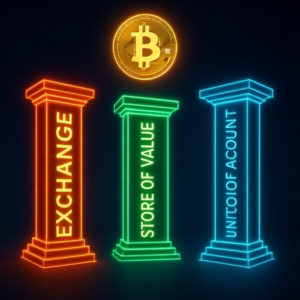
Exchange, Savings, and Measurement: Money’s Core Roles
None of this growth is possible without money serving all three of its roles.
It must be a medium of exchange so people can specialize.
It must be a store of value so people care about the future and choose investment over instant consumption.
And it must be a unit of account so producers can calculate profit and loss with accuracy.
This is why so many people explore Bitcoin today. It delivers scarcity, stability, and clarity.
What History Teaches Us About Good and Bad Money
Across history, many goods have served as money.
Each one offered different levels of hardness and soundness.
These differences depended on the technology of the time.
Societies once used seashells, salt, and cattle.
Later they turned to silver and gold.
Eventually they used government money backed by gold.
What Modern Legal Tender Reveals About Money
Today, almost every nation relies on legal tender created by the state.
Each step in this evolution brought benefits.
Yet each step also brought new risks.
By studying these materials and the tools used to make them, we learn a lot about money itself.
Why Bitcoin Makes Sense Only After Studying the Past
We can see what makes a monetary good strong and what makes it weak.
We learn which properties protect savings and which destroy them.
Only after seeing this long journey can we understand how Bitcoin fits into the story.
Its role as a modern monetary medium becomes far clearer when we place it in the full context of human history.

Why Earlier Forms of Money Help Us Understand Bitcoin’s Role
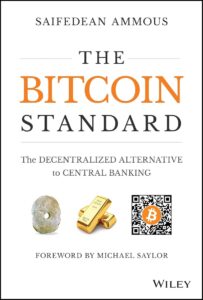
The Bitcoin Standard explores many unusual objects that once served as money.
In future posts, we will dive into these examples.
They include the massive Rai stones of Yap Island, seashells used in the Americas, glass beads in parts of Africa, and even cattle and salt in older civilizations.
Each of these items worked as money only when it had one of the strongest stock-to-flow ratios available to the people using it.
When it lost that strength, it stopped functioning as money.
Understanding why these shifts happened helps us see how money evolves—and how Bitcoin may fit into that long story.
If you want to understand how rebels approach ownership and self-custody, this [Rebel’s guide to Bitcoin] explains the basic of Bitcoin ownership.
A Preview of the Money Lessons Ahead
Later posts in this series will also cover the topics that The Bitcoin Standard lays out.
For example, what the book refers to as “Chapter 3” analyzes monetary metals and explains how gold became the dominant global money by the late nineteenth century.
What it calls “Chapter 4” looks at the rise of government money and evaluates its historical record.
Then, in the sections known as Chapters 5, 6, and 7, the book examines the economic and social impact of different forms of money.
Finally, what The Bitcoin Standard presents as Chapter 8 introduces Bitcoin and explains its monetary properties in detail.
Understanding Money’s Past to See Bitcoin’s Future
The story of money is a story of human progress.
Each society chose the money that worked best with its tools, its technology, and its needs. Some forms failed because they became easy to produce.
Others thrived because they stayed scarce, durable, and widely accepted.
This pattern shaped every stage of economic development. It also shaped how people saved, invested, and planned for the future.
Bitcoin: A Modern Solution to a Broken System
Today, Bitcoin enters this long line of monetary innovation.
Its fixed supply and open network make it a modern form of hard money.
It cannot be inflated at will. It does not depend on political decisions.
And it offers a clear, global standard for storing value.
If you want to begin your own shift toward hard money, you can claim $10 in free Bitcoin
It supports your journey and helps me continue creating content that challenges a broken financial system.

Final Thoughts: Why Bitcoin Matters in a Changing World
As we explore the money of the past—from Rai stones to gold—we also see the path ahead.
Bitcoin is not an accident.
It is the next chapter in a very old story: the search for a reliable, scarce, and freely chosen monetary standard.
Understanding this history prepares us for what comes next.