
Few criticisms of Bitcoin are repeated as often as the claim that mining is a waste of energy.
At first glance, the idea of spending electricity on solving abstract mathematical problems can seem unnecessary or even reckless.
However, that criticism misunderstands what Bitcoin mining actually does, why it exists, and what role energy plays in securing digital money.
How Bitcoin Moves Value Without Trust
Anyone who joins the Bitcoin network generates two things: a public address and a private key.
The public address functions like an email address.
It can be shared freely so others can send bitcoin to it.
The private key functions like a password and is used to authorize spending from that address.
When a transaction is created, it is broadcast to the network.
Nodes across the world independently verify that the sender has a sufficient balance and has not already spent those coins elsewhere.
Once verified, the transaction becomes eligible to be added to the shared ledger.
However, simple voting would not work in an open network.
A malicious actor could create thousands of fake nodes and approve fraudulent transactions.
Because of this, Bitcoin does not count votes by identity.
Instead, it counts votes by work performed.

If you’re ready to break free from banks, middlemen, and financial lies, read How to Buy Bitcoin: A Rebel’s Guide to Freedom and learn exactly how working people can start owning real money on their own terms.
Why Proof-of-Work Is Necessary
Bitcoin solves the double-spending problem through proof-of-work (PoW).
In this system, network participants compete to solve mathematical problems that are difficult to solve but easy to verify.
Solving these problems requires real-world resources: electricity and computing power.
Every ten minutes, verified transactions are grouped into a block.
Nodes compete to solve the PoW puzzle for that block.
The first node to produce a valid solution broadcasts it to the network, where it can be verified almost instantly by other nodes.
Once verified, the block is added to the ledger. The node that solved the puzzle receives a reward made up of two parts:
-
A block subsidy (newly issued bitcoin)
-
The transaction fees paid by users in that block
This process is called mining.
It is the only way new bitcoin enters circulation, just as mining is the only way new gold enters the market.

Energy as the Foundation of Digital Scarcity
At first glance, proof-of-work may appear wasteful. In reality, it serves a critical function.
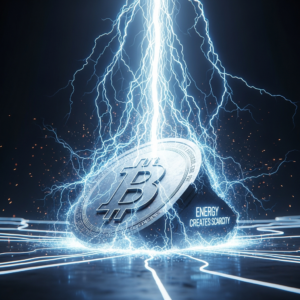
It makes the production of bitcoin reliably expensive.
Digital objects are easy to copy. Without cost, scarcity cannot exist.
Proof-of-work introduces cost into the system by tying digital issuance to physical resources.
Electricity is converted into security and truth.
Because solving PoW is expensive and verifying it is cheap, dishonest behavior is strongly discouraged.
Any miner who includes invalid transactions will lose the block reward while still paying the electricity cost.
Fraud becomes irrational.
Key economic asymmetry created by PoW:
-
High cost to produce blocks
-
Near-zero cost to verify blocks
-
Severe penalties for dishonest behavior
Why Attacking Bitcoin Is Economically Irrational
To insert fraudulent transactions, an attacker would need to control more than 50% of the total network processing power.
That level of power was theoretically possible in Bitcoin’s early days.
However, the network had little or no economic value at the time, so no one bothered.
As Bitcoin grew, the cost of attack rose dramatically.
By 2017, the processing power behind Bitcoin exceeded:
-
~2 trillion consumer laptops
-
~2 million times the world’s largest supercomputer
-
~200,000 times the top 500 supercomputers combined
Bitcoin became the largest single-purpose computer network ever created.
An attacker attempting to alter the ledger today would need to invest hundreds of millions—or billions—of dollars into specialized hardware.
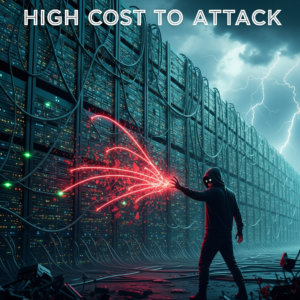
Even worse, success would destroy the value of the bitcoin they hoped to steal.
In short:
-
Attacks are extremely expensive
-
Success makes the reward worthless
-
Honest nodes can revert and continue
ASICs and the Evolution of Mining
Mining has evolved from hobbyist computers to specialized machines called ASICs (Application-Specific Integrated Circuits).
These devices are built for one purpose only: running Bitcoin’s proof-of-work efficiently.
ASICs waste no electricity on unrelated computation.
They exist solely to secure the Bitcoin network.
If Bitcoin were to fail, these machines would become useless overnight.
This creates a powerful incentive.
Miners are economically motivated to protect the network’s integrity because their hardware investment depends on it.
Separation of Roles Without Centralization
In Bitcoin’s early days, users ran nodes, stored wallets, and mined coins on the same machines.
Over time, roles became specialized.
Wallet providers, node operators, and miners now serve different functions.
Despite this specialization, decentralization remains intact.
No single party controls the ledger. No authority can alter balances unilaterally.
A large and distributed set of nodes continues to verify the system independently.
Specialization increased security by allowing total processing power to grow far beyond what general-purpose computers could achieve.

Why Bitcoin Keeps Surviving Attacks
Bitcoin was designed from the start to operate in a hostile environment.
Hackers worldwide have attempted to exploit it for over a decade.
Yet confirmed transactions have never been successfully double-spent.
This is not accidental. Bitcoin survives because:
-
Trust is removed
-
Verification is mandatory
-
Incentives punish dishonesty
-
Participation is voluntary
Any successful attack would signal that Bitcoin is broken.
Users could immediately leave.
The system only functions if it remains honest.
For those serious about long-term Bitcoin accumulation, Swan Bitcoin offers automated buys, free withdrawals, assisted self-custody, and advanced services for families and businesses—start today and get $10 in free Bitcoin.
Is Bitcoin Mining Really a Waste?
The claim that Bitcoin “wastes electricity” misunderstands value itself.
Electricity is produced to satisfy demand.
If people are willing to pay for it, it is not wasted.
Bitcoin users willingly finance mining through transaction fees and block rewards.
That electricity secures a global, censorship-resistant, inflation-proof monetary system.
Proof-of-work is not wasted energy. It is the price paid for digital hard money.
| System | What energy buys | Who controls it |
|---|---|---|
| Banking | Trust + inflation | Institutions |
| Bitcoin | Security + truth | Network users |
Conclusion: Energy Spent on Truth
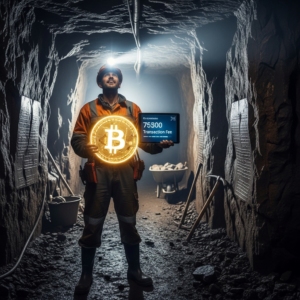
Bitcoin mining converts electricity into an incorruptible ledger.
It replaces trust with verification and incentives.
It makes fraud expensive and honesty profitable.
When viewed this way, mining is not wasteful. It is foundational.
Proof-of-work is the only method humanity has discovered for creating digital scarcity without trust.
If people continue to find that worth paying for, the energy is being used exactly as intended.