
For centuries, the architecture of money has been controlled by powerful central institutions.
Kings, governments, and central banks have held the exclusive authority to create and manage the currency we use every day.
This system is built on trust in fallible human institutions—and it has failed us repeatedly.
It has produced endless cycles of inflation, enabled financial censorship, and steadily eroded our economic sovereignty.
We are told this is the only way.
We are told we must rely on intermediaries to manage our most valuable asset: our time and labor, stored as money.
This is a lie.
A new paradigm has emerged from the digital frontier.
It offers a radical alternative. It is called Bitcoin.

If you’re brand new and want a simple, no-nonsense walkthrough, this Rebel’s Guide to Buying Bitcoin breaks down everything step by step.
Bitcoin: Power Back to the Individual
More than a cryptocurrency or an investment asset, Bitcoin represents a fundamental philosophical and technological breakthrough.
It is a tool for human empowerment, a defense against economic tyranny, and arguably the most important monetary innovation of our lifetime.
This article will explain why Bitcoin matters—breaking down its core properties and the profound implications it holds for the future of money and individual freedom.
The Foundation of Freedom: Bitcoin’s Core Properties
To understand Bitcoin’s importance, one must first understand what it is at a functional level.
It is not a company stock nor a traditional currency.
It is a decentralized, cryptographic protocol that enables peer-to-peer value transfer.
Its revolutionary nature is best understood through its defining characteristics.
1. Permissionless and Borderless
The traditional financial system is a gated community.
Participation requires permission.
You must provide identification, submit to credit checks, and obey rules written by banks and governments.
Your access can be revoked at any time.
Bitcoin shatters these gates.
It is a global, open network. Anyone, anywhere, with an internet connection can participate.
There are no forms to fill out and no accounts to approve.
Financial inclusion is the default, not a privilege.
This eliminates geographic and socioeconomic barriers, granting billions of unbanked individuals access to the global economy for the first time.

2. Censorship Resistance
In today’s world, financial platforms routinely de-bank individuals and organizations for political or social reasons. Bitcoin offers an escape.
A Bitcoin transaction cannot be blocked, altered, or reversed by any government, corporation, or individual.
Once cryptographically signed and confirmed by the network, it is immutable.
This property is vital for journalists, activists, and dissidents operating under authoritarian regimes—but it also protects ordinary users.
Your ability to transact is enforced by mathematics, not by the approval of a third party.
3. Decentralized and Anti-Fragile
Bitcoin has no headquarters. No CEO. No control room.
It is maintained by a global network of independent nodes and miners.
This decentralization is its greatest strength. There is no single point of failure.
To compromise Bitcoin, an attacker would need to dismantle a vast, globally distributed system simultaneously—a near-impossible task.
Bitcoin is anti-fragile.
Attempts to attack, ban, or regulate it often strengthen the network by forcing further decentralization and innovation.
Unlike fragile centralized systems, Bitcoin grows stronger under pressure.
4. Absolute Scarcity: Digital Gold
This is Bitcoin’s most economically important feature.
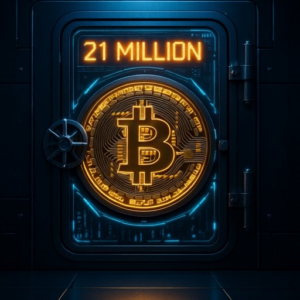
There will only ever be 21 million bitcoin.
This hard cap is enforced by code and visible to anyone who verifies the network.
New coins are issued on a predictable schedule and cut in half roughly every four years in an event known as the halving.
This stands in stark contrast to fiat currencies, which central banks can create in unlimited quantities.
Bitcoin’s absolute scarcity makes it a uniquely powerful store of value.
While inflation erodes savings, Bitcoin’s purchasing power is designed to increase over time.
It is digital gold—but superior: easier to secure, easier to transfer, easier to verify, and auditable by anyone.
5. Self-Sovereignty and Resistance to Confiscation
“Not your keys, not your crypto.”
This principle sits at the heart of Bitcoin.
When you hold Bitcoin in self-custody, you control the private keys that grant access to your funds.
You become your own bank.
Your wealth cannot be frozen, seized, or arbitrarily restricted by a bank failure, government decree, or institutional collapse—provided you secure your keys properly.
Bitcoin restores financial sovereignty to the individual, reversing a power imbalance that has existed for generations.
Bitcoin as the Answer to a Broken System
Bitcoin did not appear by accident.
It was launched in early 2009 by the anonymous Satoshi Nakamoto, immediately following the 2008 global financial crisis—a crisis that exposed deep flaws in the modern financial system.
Excessive leverage. Reckless risk-taking. Bailouts for the powerful. Losses socialized onto the public.
Bitcoin was built as a response.
The Inflationary Disease
The standard solution to financial crises is money creation.
Through tools like Quantitative Easing, central banks generate currency from nothing.
This dilutes the value of every existing unit—a hidden tax known as inflation.
Savings are eroded. Thrift is punished. Asset bubbles inflate.
During the COVID-19 response, this process accelerated dramatically, with over 30% of all U.S. dollars ever created issued in a short span of time.
In this environment, holding cash guarantees loss of purchasing power.
Bitcoin offers an escape.
Its fixed supply makes it a hedge against inflation and a defense against monetary debasement.

If you want to understand who built this rigged system and why they fear alternatives like Bitcoin, read 16 Forbidden Books on Money the Establishment Hates—a curated list of works they never wanted working people to find.
The Rise of Financial Censorship
Beyond economics, Bitcoin addresses a growing political problem: financial control.
Accounts are frozen. Donations are blocked. Access to the economy is increasingly conditional.
Bitcoin’s censorship resistance ensures that peaceful, lawful transactions cannot be stopped.
It protects charitable giving, enables support for controversial causes, and preserves economic participation as a right—not a revocable privilege.
Bitcoin in the Real World
Bitcoin’s importance is not theoretical.
-
For the unbanked: Over 1.4 billion people lack basic banking access. With a mobile phone, Bitcoin gives them a global financial identity.
-
For remittances: Bitcoin enables near-instant, low-cost cross-border payments, bypassing predatory intermediaries.
-
For crisis economies: In countries suffering hyperinflation or capital controls, Bitcoin preserves wealth when local currencies fail.
-
For innovation: The Lightning Network enables instant, near-free microtransactions, opening new economic models for the digital age.

To see how this fight ends—and why digital cash threatens financial censorship itself—read Bitcoin and the Future of Digital Cash Systems, where the coming shift away from bank-controlled money is laid out clearly and without illusions.
Addressing the Critics
Bitcoin faces legitimate scrutiny.
These concerns deserve honest answers.
Criminal use:
Like cash, Bitcoin can be abused.
However, its public ledger makes forensic analysis easier than with physical money.
The benefits of financial freedom outweigh this risk.
Energy consumption:
Bitcoin uses energy by design.
That energy secures the network, making it the most robust monetary system ever built.
Miners increasingly use stranded and renewable energy, often stabilizing power grids.
Volatility:
Bitcoin is still discovering its global price.
Volatility decreases as adoption grows.
This is the natural maturation of a new asset.

The Future Is Sovereign
Bitcoin is more than an asset.
It is a shift away from centralized control and toward individual sovereignty.
It offers:
-
Economic empowerment against inflation
-
Political empowerment against censorship
-
Personal empowerment through self-custody
A neutral, global, sound money now exists. It cannot be uninvented.
Understanding Bitcoin is no longer optional for those who value freedom.
Adoption is not merely an investment decision—it is a step toward a more resilient and sovereign future.

For those seeking a disciplined way to build a position over time, platforms like Swan Bitcoin allow automatic recurring purchases, helping individuals accumulate steadily without reacting to short-term volatility.
The architecture of money has changed.
The question is whether you will adapt—or remain subject to a system that has already failed you.