
Not every form of money survives. Some thrive for centuries.
Others collapse fast once new technology makes them easy to produce.
One powerful example comes from West Africa, where aggry beads once served as money.
Their story mirrors the pattern seen throughout monetary history.
When hardness disappears, wealth disappears with it.
And this same pattern helps explain why Bitcoin enters the conversation as modern hard money that cannot be inflated at will.
When Ancient Money Teaches Us About Hardness
Aggry beads were used as money in western Africa for centuries.
Their history is unclear.
Some say they came from meteorite stones.
Others believe they were traded by Egyptian or Phoenician merchants.
What historians do know is simple: glassmaking was rare and expensive in that region.
That made these beads hard to produce, which gave them a high stock-to-flow ratio.
Because of this, they held value over long periods.
Aggry Beads: When Rarity Creates Value
Aggry beads were also salable across scale.
People could combine them into necklaces, bracelets, or chains.
However, they were not ideal for price measurement because there were many types of beads instead of one standard unit.
They were also easy to move, giving them salability across space.
Yet their value depended entirely on rarity. That rarity did not exist in Europe.
Why Aggry Beads Failed When Europeans Arrived
In Europe, glassmaking was common. Beads were not expensive.
Producers could flood the market with them if they were treated as money.
This difference mattered the moment Europeans reached West Africa in the sixteenth century.
They saw the high value Africans placed on these beads and began importing massive quantities from Europe.
What happened next was slow, covert, and tragic.
Europeans bought enormous amounts of African resources using beads that cost almost nothing to produce back home.
As more beads arrived, their value dropped. Their stock-to-flow ratio collapsed.
Their salability faded. And the Africans who held them suffered massive losses of purchasing power.

A Warning from History: The Parallels to Modern Fiat
Aggry beads later became known as slave beads because they played a major role in fueling the slave trade.
Europeans could acquire beads cheaply, while Africans paid dearly.
This difference—slow drain versus sudden collapse—matters.
A sudden monetary crash is painful, but it ends quickly.
A slow erosion steals wealth generation after generation.
This lesson becomes important when we discuss the soundness of government money in later blog posts.
Seashells: Global Money With Local Limits
Seashells were used as money in many places, from North America to Africa to Asia.
The shells that held value were the ones that were hard to find.
Their scarcity gave them a high stock-to-flow ratio.
Native Americans and early settlers relied heavily on wampum shells, which were extremely difficult to harvest.
But seashells had the same flaw as beads: they were not uniform units.
This made price measurement slow, unclear, and unreliable.
Economic specialization requires clear units, and seashells could not provide that.
For readers who want to explore the deeper history of seashell money, Nick Szabo’s classic paper Shelling Out: The Origins of Money (2002) is one of the best introductions available.
Szabo explains why seashells worked as early money and how scarcity protected their value.

Better Boats, Broken Money: How Efficiency Killed Scarcity
European settlers adopted shells as legal tender in 1636.
But when gold and silver coins arrived from Britain, people preferred them.
Coins were uniform. They were easy to measure. They gave better price clarity.
Soon, metal money had higher salability.
Then technology changed everything.
Better boats made it easier to collect shells in huge numbers.
Supply exploded. Stock-to-flow collapsed.
By 1661, seashells stopped being legal tender. Soon after, they lost all monetary value.
This same fate appeared worldwide.
Whenever societies gained access to uniform metal coins, they switched—and benefited.
Salt and Cattle: Money Before Metal
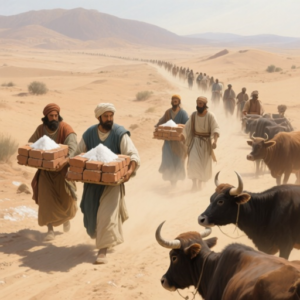
Many ancient economies used cattle as money.
Cattle were valuable as food and were salable across space because they could move.
Some societies still use them today for dowries and payments.
But cattle were hard to divide.
They could not solve the problem of precision in trade.
Salty Origins: How Salt Earned Its Monetary Status
Salt became the complementary money of choice.
Salt was durable. It was divisible. It was easy to store.
The impact of these early forms of money can still be seen in language:
-
Pecuniary comes from pecus — Latin for cattle
-
Salary comes from sal — Latin for salt
Measurable and Defensible: The Practical Edge of Coinage
As technology improved, especially with metallurgy, humans replaced these artifacts with metal money.
Metals could be standardized.
They were easier to transport.
They could be minted into uniform units.
Anyone interested in understanding how ancient forms of money evolved into metal-based money can explore Antal Fekete’s Whither Gold? (1997).
It won the 1996 International Currency Prize and provides valuable insight into why gold and other metals replaced cattle, salt, stones, and shells.

Industrial Technology Ends the Age of Artifact Money
Hydrocarbon fuels later accelerated production.
Boats became more powerful. Quarrying stone became easier. Glass beads could be mass-produced.
As a result:
-
Rai stones could be quarried cheaply
-
Aggry beads could be made for almost nothing
-
Seashells could be collected in huge quantities
“Easy Production, Empty Value”: The Fundamental Flaw
All artifact money collapsed for the same reason: their hardness vanished.
Societies that relied on them lost wealth rapidly.
Their entire monetary system unraveled.
The chiefs on Yap Island understood something modern economists still struggle to accept:
“A money that is easy to produce is no money at all.”
Easy money weakens a society.
It sells off the savings of its people in exchange for something cheap to create.
Hard money protects wealth. It protects time.

The Universal Pattern of Monetary Collapse
The details differ across cultures and centuries. But the dynamic is always the same.
When the stock-to-flow ratio falls, a money fails.
Trust disappears. Purchasing power collapses.
This pattern is still repeating today.
The Venezuelan bolivar is undergoing this exact process as these words are written.
Money must be hard to survive.
And for the first time in history, we now have a form of money whose hardness cannot be weakened by technology, politics, or production shortcuts.
If you want to explore money that cannot be inflated, you can start with $10 in free Bitcoin.
This supports your journey into hard money—and helps me keep building content that challenges a broken financial system.

Whether you’re starting with $10 or $1,000, this [Bitcoin beginner roadmap] shows exactly where to begin.
Final Thoughts: Why History Points Directly to Bitcoin
Every failure of artifact money reveals one truth: hardness matters.
Societies that relied on fragile monies lost wealth.
Societies that adopted harder money grew stronger and more stable.
Bitcoin sits at the end of this long history as a new form of money that restores hardness in a digital age.
Its fixed supply makes it immune to the pitfalls that destroyed seashells, beads, stones, salt, and cattle.
Understanding the failures of the past makes Bitcoin’s design far clearer.